Memory Care Costs in Princeton: A Guide for Mercer County Families
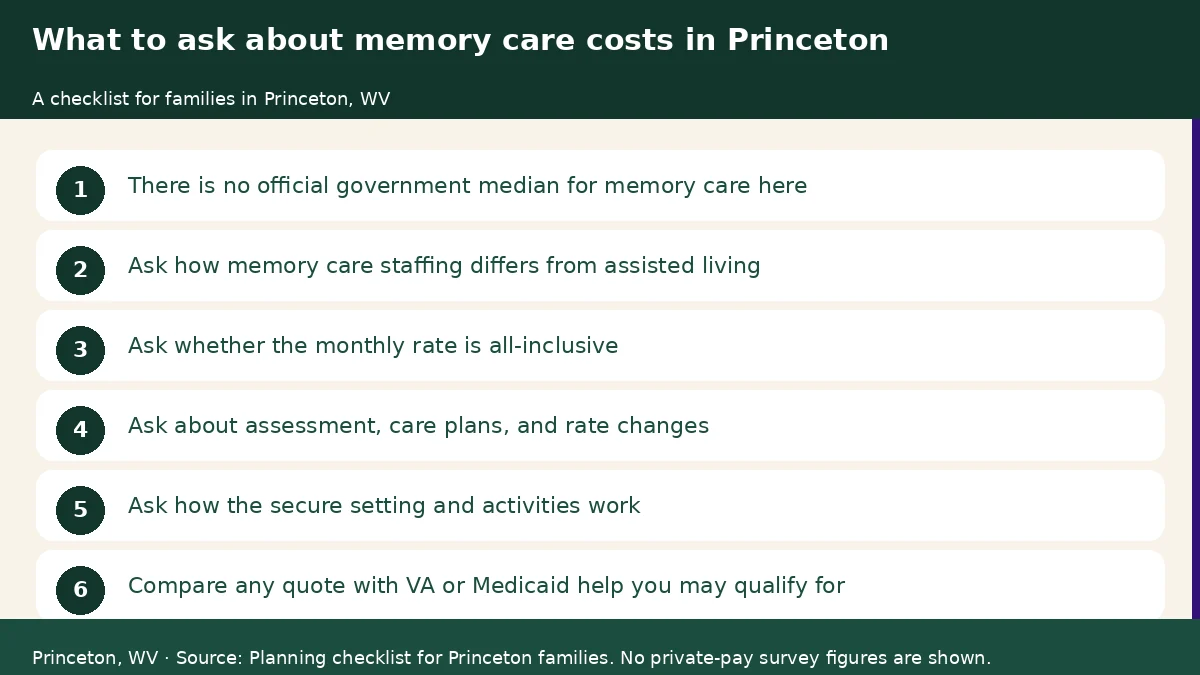
There is no official federal or West Virginia survey that publishes a private-pay median for memory care in Princeton. Memory care is usually priced higher than standard assisted living because of staffing, training, and a more structured setting, but the only reliable figure is a written quote.
Medicare does not pay for room, board, or ongoing custodial care in assisted living if that is the only care someone needs (Medicare.gov: long-term care coverage).
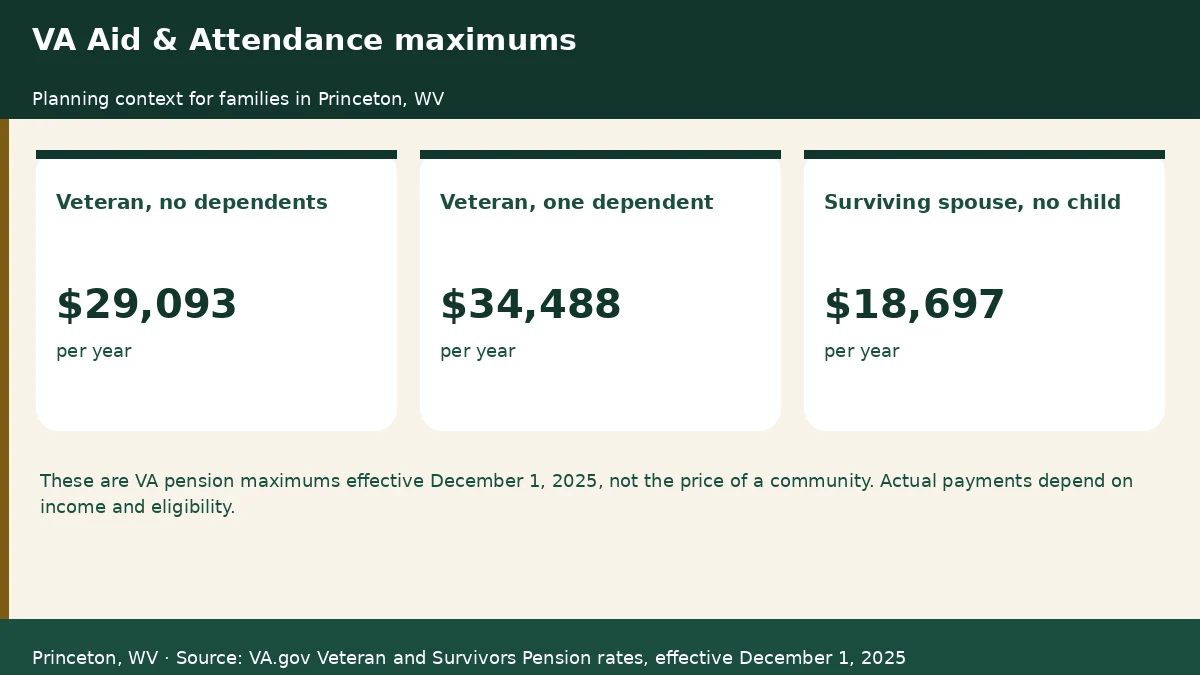
Eligible wartime Veterans and surviving spouses can review VA pension with Aid and Attendance. As of December 1, 2025, the maximum annual pension rate with Aid and Attendance is $29,093 for a Veteran with no dependents and $34,488 for a Veteran with one dependent (current VA pension rates). A surviving spouse’s Aid and Attendance maximum is $18,697 a year with no dependent children (VA Survivors Pension rates). These are benefit limits, not the price of a Princeton community. The net worth limit for these pensions is $163,699 from December 1, 2025, through November 30, 2026.
For local public-benefit counseling, start with the federal Eldercare Locator at 1-800-677-1116, which connects families to the Area Agency on Aging that serves Princeton, West Virginia.
When a parent in Princeton is living with Alzheimer's disease or another form of dementia, families often reach a point where home, or even standard assisted living, no longer feels safe. Memory care is the next option many consider. It also costs more, and precise local figures are hard to find. This guide explains what published data shows for southern West Virginia, why memory care costs more, how West Virginia licenses dementia care settings, and how Mercer County families can plan.
What the data shows
That is a national figure for one type of community, not a local price; we include it only to show the general relationship. Ask each provider for written memory care rates.
Why memory care costs more
- More staff time. People living with dementia often need cueing or hands-on help with each step of the day.
- Supervision around the clock. Evening confusion, night waking, and attempts to leave call for attentive staff at all hours.
- Training. Staff need skills in calm redirection and in communicating when words become difficult.
- A safer environment. Secured exits, simple layouts, and calm spaces reduce risk and confusion.
- Structured days. Routines and activities adapted to each person's abilities.
Memory care provides support and a safer environment. It does not cure dementia or slow its progression.
How West Virginia licenses dementia care
West Virginia's Office of Health Facility Licensure and Certification (OHFLAC), part of the Office of the Inspector General, licenses health care facilities in the state. Its list of facility types includes Assisted Living Residence, Nursing Home, Residential Care Community, and a separate category for Alzheimer's/Dementia Special Care Units (OHFLAC). When a community describes memory care, ask how its program is licensed and what that means for staffing and resident safety.
West Virginia law defines an assisted living residence as a place serving four or more residents who need personal assistance or supervision, and who may require nursing care no greater than limited and intermittent nursing care (W. Va. Code § 16B-5-2). That limit matters for people with advanced dementia who develop complex medical needs. Our article on West Virginia assisted living licensing explains more.
Signs memory care may be needed
- Wandering, trying to leave, or getting lost on familiar roads
- Unsafe use of the stove, car, or medications even with reminders
- Needing step-by-step help with dressing, bathing, or eating
- Increased confusion or agitation in the late afternoon and evening
- Frequent nights awake
- Not recognizing danger
In a rural area, a parent who wanders can quickly end up far from help, on a busy road or in woods. That makes supervision especially important. See our article on assisted living versus memory care in Princeton.
Paying for memory care in West Virginia
- Private pay from income, savings, and home equity is the most common source.
- West Virginia Medicaid does not have an assisted living waiver; its Aged and Disabled Waiver serves people in their own homes rather than in assisted living (West Virginia Aged and Disabled Waiver Program). Medicaid can cover nursing home care for people who qualify.
- VA benefits. Eligible veterans and surviving spouses may qualify for a pension with Aid and Attendance (VA pension rates).
- Long-term care insurance often covers memory care when cognitive impairment is documented.
Our guide to paying for assisted living in West Virginia has details.
Planning ahead
- Get a medical evaluation, because some causes of memory loss are treatable.
- Ask the doctor what supervision your parent is likely to need in the coming year.
- Get written quotes from two or three options.
- Ask how rates change as needs grow.
- Put powers of attorney and advance directives in place while your parent can still take part.
The value of a campus setting
Some families in Mercer County look for a campus where several levels of care are available in one place, so that a parent can move from assisted living to a more supportive setting without leaving familiar surroundings and staff. If that matters to you, ask exactly which services are available on site today, how transfers between levels work, and how costs change.
Caring for the caregiver
Many Princeton families care for a parent with dementia at home for years before considering memory care. That care is demanding, and caregiver exhaustion is one of the most common reasons families make a change. Short respite stays, adult day programs, and support groups can help in the meantime. Choosing memory care is not giving up; for many families it means a parent gets steady support while the family can return to being a son, daughter, or spouse.
Local help
The Aging and Disability Resource Center serving Mercer County is in Princeton at 109 Thorn Street, (304) 425-2040, and the statewide ADRC number is 866-981-2372 (West Virginia Aging and Disability Resource Center). Staff can help families learn about local services, respite, and long-term care options.
Questions to ask about memory care pricing
- What does the monthly rate include?
- Are there extra charges as care needs increase?
- How often are residents reassessed?
- How is your memory care program licensed?
- What happens if my parent's needs exceed what you can provide?
Talk with GlenWood Park
GlenWood Park, at 1924 Glenwood Park Road in Princeton, lists memory care among its care paths. Because programs and naming can change, please call (304) 425-8128 to confirm how memory care support is structured today, along with current availability and rates.
Frequently asked questions
How much does memory care cost in Princeton, WV?
Ask providers for written quotes.
How much more is memory care than assisted living?
There is no official federal or West Virginia private-pay median published for this type of care in Princeton. Ask each community for a written quote after an assessment.
Does West Virginia license memory care?
OHFLAC lists Alzheimer's/Dementia Special Care Units as a separate facility type, along with assisted living residences and nursing homes.
Does West Virginia Medicaid pay for memory care in assisted living?
West Virginia Medicaid does not have an assisted living waiver. Medicaid can cover nursing home care for people who qualify.