West Virginia Assisted Living Licensing, Explained for Princeton Families
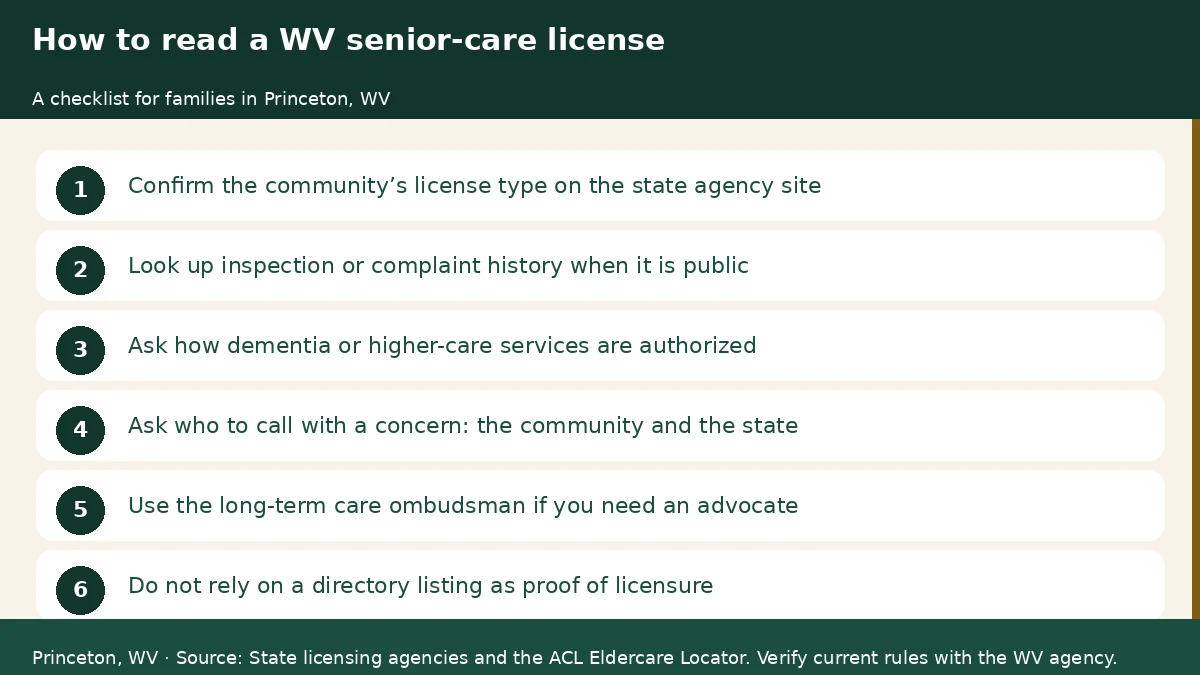
When you are choosing assisted living for a parent in Princeton, it helps to understand how West Virginia regulates these communities. A license is not a guarantee of quality, but it tells you that a residence is subject to state standards and inspections, and it shapes what kind of care the residence can provide. This guide explains the key rules in plain language and shows you where to check a license and get help.
Who licenses assisted living in West Virginia
Assisted living residences are licensed by the Office of Health Facility Licensure and Certification (OHFLAC), part of West Virginia's Office of the Inspector General. OHFLAC licenses many kinds of facilities. Its list includes Assisted Living Residences, Residential Care Communities, Nursing Homes, and Alzheimer's/Dementia Special Care Units (OHFLAC). OHFLAC can be reached at (304) 558-0050.
What counts as an assisted living residence
West Virginia law defines an assisted living residence as any facility, however named, serving four or more residents, that offers personal assistance or supervision to residents who depend on others because of physical or mental impairment (W. Va. Code § 16B-5-2). "Personal assistance" includes help with walking, bathing, dressing, eating, getting in or out of bed, and supervision needed because of age or mental impairment.
The law excludes some settings, such as care of relatives in a household, hotels and boarding homes that furnish only room and board, and hospitals.
The limit on nursing care
One of the most important rules for families is the limit on nursing care. An assisted living residence may provide nursing care at a level no greater than "limited and intermittent nursing care." The law defines that as direct, hands-on nursing care for a resident who needs no more than two hours of nursing care a day, for no longer than 90 consecutive days per episode. The time limits do not apply to a resident who receives hospice services coordinated by a licensed hospice, or to home health services provided by a Medicare-certified home health agency. Limited and intermittent nursing care must be provided by or under the supervision of a registered nurse (W. Va. Code § 16B-5-2).
The law also allows residents to arrange privately paid nursing care or personal assistance beyond what the residence provides, with the residence's consent and cooperation (W. Va. Code § 16B-5-6).
In practice, this means assisted living is designed for people whose medical needs are stable. If a parent needs ongoing daily skilled nursing, a nursing home may be needed. Our article on assisted living versus nursing home costs in Princeton explains the differences.
License requirements
State law and the assisted living rule set out several basic requirements:
- A license is required. No one may establish, operate, offer, or advertise an assisted living residence in West Virginia without a valid license (W. Va. Code § 16B-5-6).
- One license per residence. Each location must be licensed separately, even if several share a name or management (W. Va. Code R. § 71-21-3).
- Licenses are not transferable. A license is valid only for the licensee and location named on it. A new owner must apply for a new license.
- Licenses are time-limited. OHFLAC may issue an initial or renewal license for up to one year, and residences must apply to renew at least 90 days before the license expires.
- Inspection before licensing. An initial license is issued after a satisfactory inspection for compliance with the rule.
- The license must be posted where residents and visitors can see it.
- Naming rules. An assisted living residence may not use words such as "nursing home" or "hospital" in its name or advertising.
What the rule covers
West Virginia's assisted living rule, Series 71-21, has sections on administrative requirements, resident rights, health care standards, activities, dietary services, fire safety and emergency preparedness, physical facilities, and penalties (W. Va. Code R. Series 71-21). If you have a question about a specific standard, you can read the relevant section, or ask the residence or OHFLAC to explain it.
Dementia special care units
OHFLAC lists Alzheimer's/Dementia Special Care Units as a separate licensed facility type. If a community advertises memory care, ask how its program is licensed and what that means for staff training, security, and activities. See our guide to memory care costs in Princeton.
How to check a residence
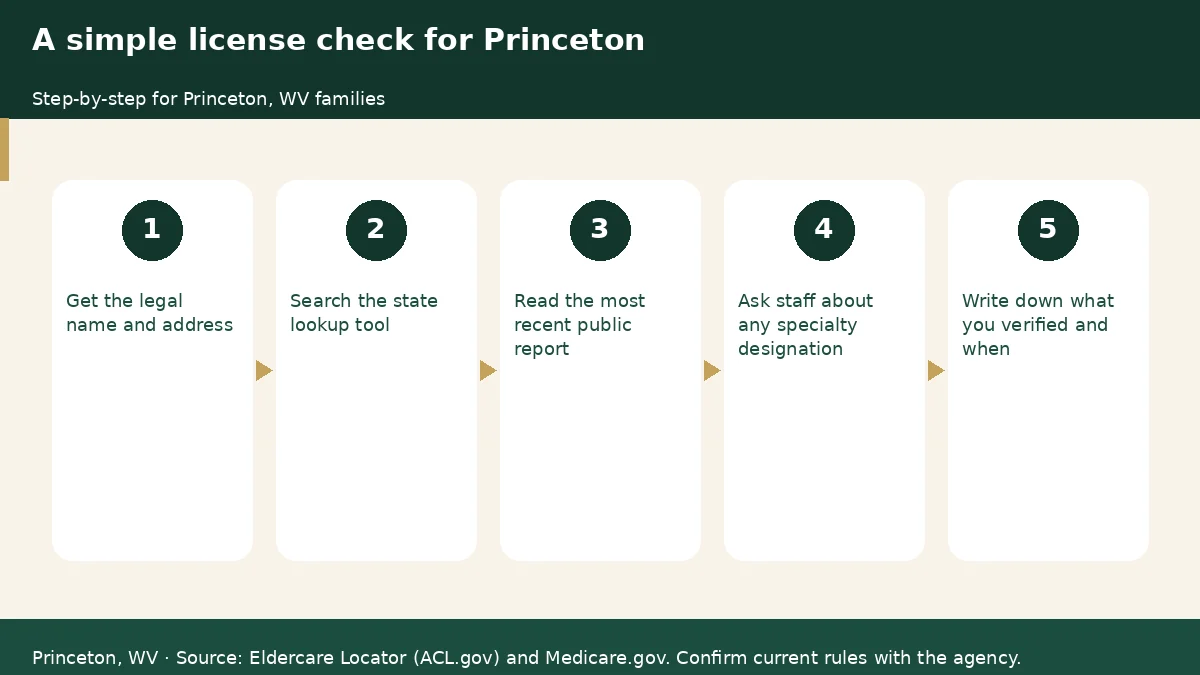
- Ask to see the license. It should be posted in plain view.
- Ask for recent survey results, including any deficiencies and how they were corrected.
- Contact OHFLAC at (304) 558-0050 with questions about a residence's license or to file a complaint.
- Talk with the ombudsman. The long-term care ombudsman program, run by Legal Aid of West Virginia, offers free, confidential help to residents and families. The Beckley regional office serves Mercer County, and the toll-free number is 800-834-0598 (Legal Aid of WV ombudsman program).
Reporting abuse or neglect
If you suspect abuse, neglect, or financial exploitation of a resident, call West Virginia's Centralized Intake line, available 24 hours a day, at 1-800-352-6513 (West Virginia Bureau for Social Services). State law makes employees of nursing homes and other residential facilities mandated reporters. In an emergency, call 911.
What licensing does not tell you
A license means a residence must meet minimum standards. It does not tell you whether the staff are warm, whether the food is good, or whether your parent will feel at home. Visit in person, more than once, and use our assisted living tour checklist to guide your questions.
Residential care communities are different
You may also see the term "residential care community" in West Virginia. OHFLAC licenses these as a separate facility type from assisted living residences. Ask any community which license it holds, since the type of license affects the services it may offer.
Residents' rights
The assisted living rule includes a section on resident rights. When you review a residency agreement, ask the community to explain how it protects residents' privacy, dignity, and choices, how residents can raise concerns, and how it handles discharges. If something seems unclear or unfair, the ombudsman can help you understand your parent's rights.
Talk with GlenWood Park
GlenWood Park is at 1924 Glenwood Park Road in Princeton. Please call (304) 425-8128 to ask about our current licensure, programs, and services, or visit our frequently asked questions and about pages.
Frequently asked questions
Who licenses assisted living in West Virginia?
The Office of Health Facility Licensure and Certification, part of the Office of the Inspector General, licenses assisted living residences.
How much nursing care can West Virginia assisted living provide?
Limited and intermittent nursing care, defined as no more than two hours a day for no longer than 90 consecutive days per episode, with exceptions for licensed hospice and Medicare-certified home health services.
How long is a West Virginia assisted living license valid?
Up to one year. Residences must apply to renew at least 90 days before expiration.
Does West Virginia license memory care?
OHFLAC lists Alzheimer's/Dementia Special Care Units as a separate facility type.