Paying for Assisted Living in West Virginia: Options for Princeton Families
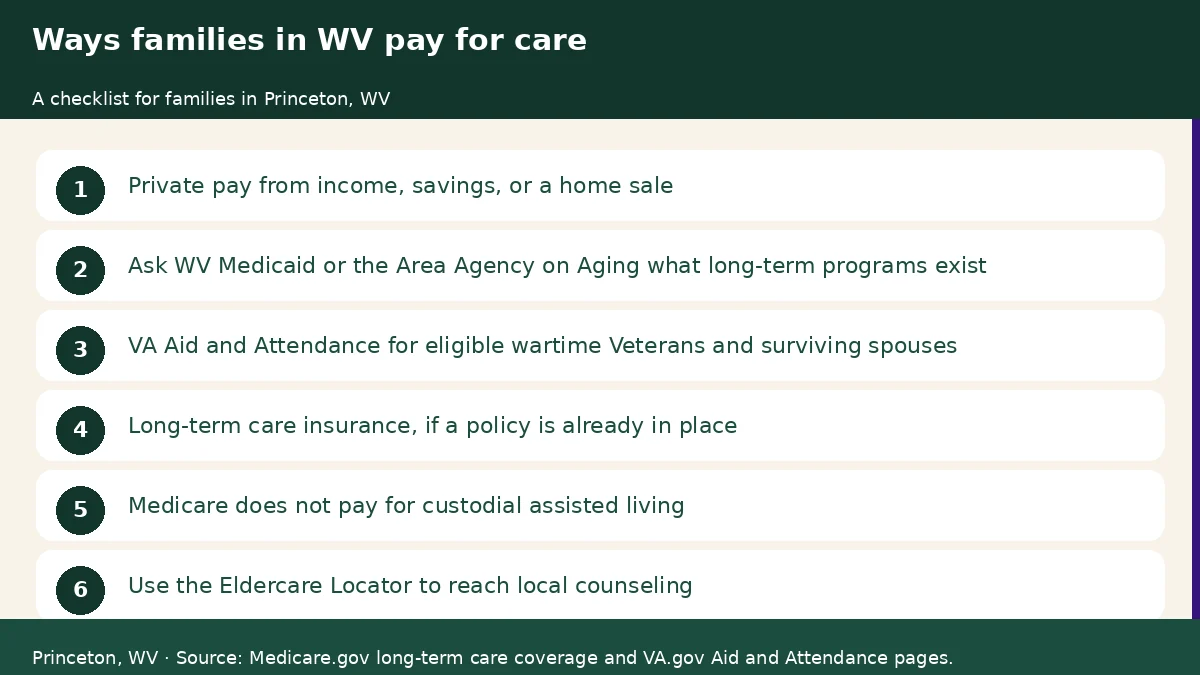
Once a Princeton family has a sense of what assisted living costs, the next question is how to pay for it. In West Virginia the answer is a little different than in many states, because the state's Medicaid program does not include an assisted living waiver. That makes careful planning especially important. This guide walks through the main sources of payment, what public programs do and do not cover, and where Mercer County families can get free help.
Start with the cost
Memory care usually costs more. Our guide to assisted living costs in Princeton explains what shapes a quote.
1. Private pay
Most assisted living in West Virginia is paid privately, from a combination of:
- Social Security and pension income
- Coal, railroad, or other retirement benefits
- Savings, investments, and retirement accounts
- Proceeds from selling a home, or rental income from it
- Help from family members
Many families combine several of these. A financial planner or elder law attorney can help you decide which assets to use first and how taxes may apply.
2. What West Virginia Medicaid covers, and what it does not
This is the point that surprises many families. West Virginia Medicaid does not have a waiver that pays for services in assisted living residences.
The state's main home and community-based program for older adults is the Aged and Disabled Waiver (ADW). It serves West Virginians age 18 and older who meet a nursing home level of care and helps them live in their own homes and communities (West Virginia Aged and Disabled Waiver Program). The state's ADW policy manual states that waiver services may not be provided in assisted living or other group residential settings (BMS Chapter 501, Aged and Disabled Waiver).
Medicaid can pay for nursing home care for people who meet medical and financial rules. So for some families, the practical public-benefit choice is between Medicaid-funded care at home through the ADW and Medicaid-funded nursing home care, while assisted living remains private pay. Rules change, so check current policy with the Bureau for Medical Services or the ADRC before making decisions.
3. VA benefits for veterans and surviving spouses
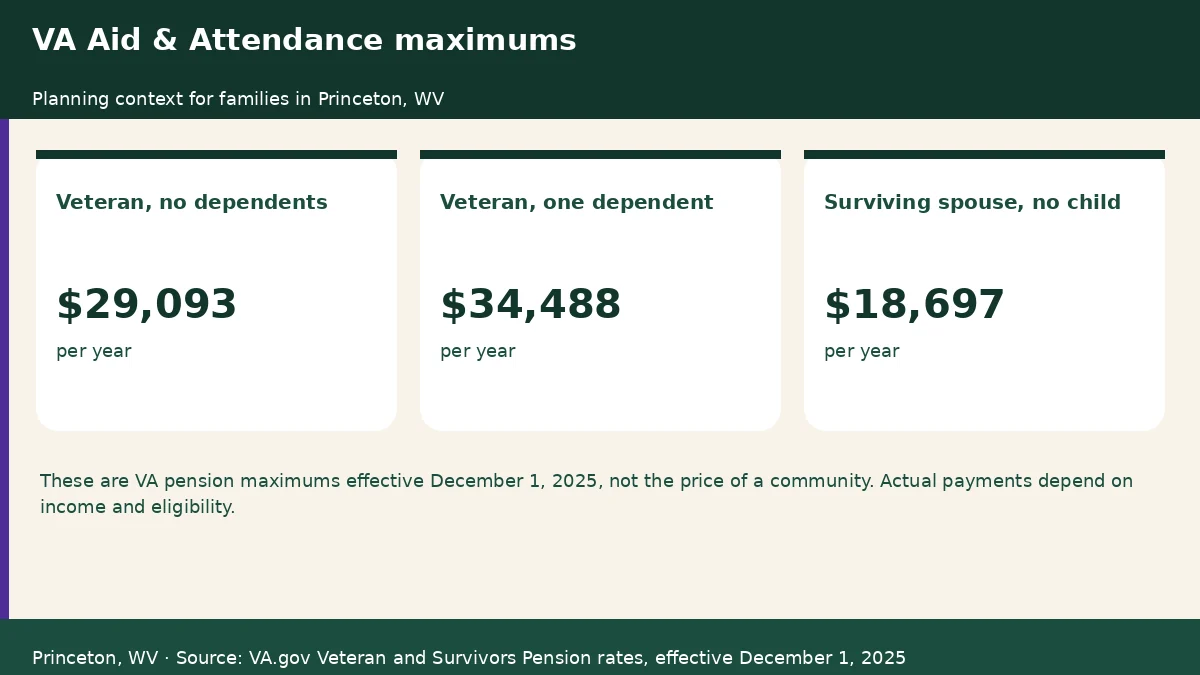
Southern West Virginia has many veterans. Eligible wartime veterans and surviving spouses with limited income may qualify for a VA pension, with an additional Aid and Attendance amount for those who need help with daily activities. For December 1, 2025, through November 30, 2026, the VA lists these maximum annual pension rates with Aid and Attendance (VA pension rates):
| Situation | Maximum annual rate |
|---|---|
| Veteran with no dependents | $29,093 |
| Veteran with one dependent | $34,488 |
| Two veterans married to each other | $46,143 |
The VA's net worth limit for the same period is $163,699. The benefit pays the difference between your countable income and the limit, and unreimbursed care costs can reduce countable income. The Beckley VA Medical Center serves veterans across southern West Virginia (VA Beckley health care). Accredited veterans service officers can help with claims at no cost.
When you apply, gather your parent's discharge papers (DD-214), recent bank statements, and a record of monthly care costs. Missing paperwork is a common reason claims are delayed, so assembling it early saves weeks.
4. Long-term care insurance
If your parent has a policy, check the benefit trigger (often help with two or more daily activities, or cognitive impairment), the elimination period, the daily or monthly maximum, and whether a licensed facility is required. Call the insurer early, because claims take time.
5. Life insurance and other assets
Some life insurance policies allow accelerated benefits for chronic illness, and some can be sold for cash. Annuities and home equity are other options. Get independent advice before using any of these, since they can affect taxes and benefit eligibility.
Where Mercer County families can get free help
- Aging and Disability Resource Center (ADRC). The ADRC serving Mercer County is at 109 Thorn Street in Princeton, (304) 425-2040, and the statewide number is 866-981-2372 (West Virginia ADRC).
- West Virginia Bureau of Senior Services. The state agency on aging can be reached at (877) 987-3646 (Bureau of Senior Services).
- Long-term care ombudsman. The free, confidential ombudsman program is operated by Legal Aid of West Virginia; the regional office in Beckley serves Mercer County, and the toll-free number is 800-834-0598 (Legal Aid of WV ombudsman program).
Putting together a plan
- Estimate the monthly cost from written quotes.
- Add up monthly income.
- Find the monthly gap.
- List savings and assets that can cover it, and how long they would last.
- Check VA and insurance benefits.
- Talk with an elder law attorney about Medicaid planning if savings may run out and nursing home care could be needed later.
- Put powers of attorney in place now.
A note on family conversations
Money conversations can be hard, especially among siblings who live in different places. It helps to share the numbers openly, agree on who will manage which tasks, and keep your parent at the center of the decision. A neutral person, such as an ADRC counselor or elder law attorney, can help a family meeting stay focused. Writing down the plan, even informally, avoids misunderstandings later.
Common mistakes to avoid
- Waiting until a crisis to look at costs and benefits
- Assuming Medicaid will pay for assisted living in West Virginia
- Giving away assets without advice, which can affect later Medicaid eligibility for nursing home care
- Overlooking VA benefits for a veteran or surviving spouse
- Choosing a community without asking how rates change as care needs grow
Talk with GlenWood Park
GlenWood Park in Princeton offers assisted living and memory care. Please call (304) 425-8128 to ask about current rates, what is included, and which payment sources are accepted, or contact us.
Frequently asked questions
Does West Virginia Medicaid pay for assisted living?
West Virginia Medicaid does not have an assisted living waiver. Its Aged and Disabled Waiver serves people in their own homes and, under state policy, may not be provided in assisted living settings.
What is the West Virginia Aged and Disabled Waiver?
It is a Medicaid program for West Virginians age 18 and older who meet a nursing home level of care, providing services that help them remain in their own homes and communities.
Can VA benefits help pay for assisted living?
Yes, for eligible veterans and surviving spouses. A veteran with no dependents can receive up to $29,093 a year with Aid and Attendance for December 2025 through November 2026.
Where can Princeton families get free help with senior care options?
The Aging and Disability Resource Center at 109 Thorn Street in Princeton, (304) 425-2040, can help.