How to Choose an Assisted Living Community in Princeton, WV
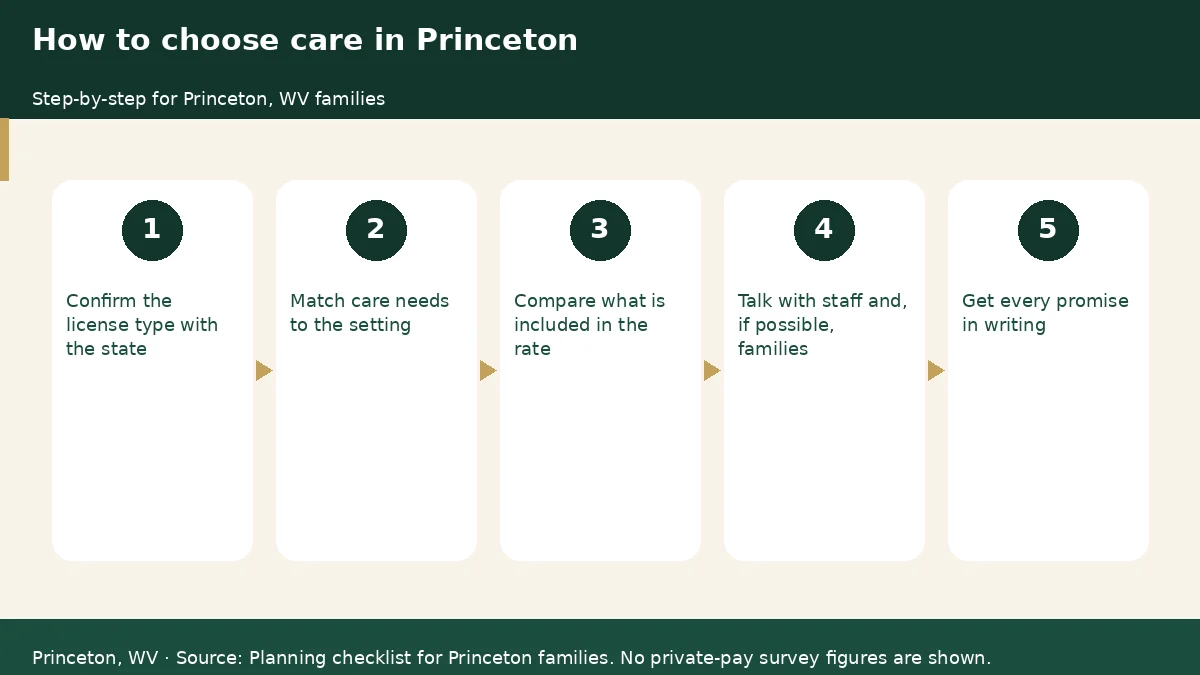
Choosing an assisted living community for a parent is one of the most important decisions a family can make. In Princeton and the surrounding parts of Mercer County, options are more limited than in a large city, which makes each choice matter more. This guide walks through the process step by step, from understanding your parent's needs to checking a community's license and making a final decision.
Step 1: Understand your parent's needs
Start by writing down what help your parent needs today:
- Personal care: bathing, dressing, grooming, toileting
- Mobility: walking, transfers, risk of falls
- Medications: how many, and whether doses are being missed
- Memory: confusion, getting lost, unsafe decisions
- Health conditions: diabetes, heart or lung disease, and any nursing needs
- Social life: loneliness, isolation, and interests
Ask your parent's doctor for input. A clear list helps you judge whether assisted living is the right setting and which communities can meet those needs.
Step 2: Know what West Virginia assisted living can provide
Under West Virginia law, an assisted living residence serves four or more residents who need personal assistance or supervision, and may provide only limited and intermittent nursing care, defined as no more than two hours a day for no more than 90 consecutive days per episode, with exceptions for hospice and Medicare-certified home health (W. Va. Code § 16B-5-2). If your parent needs ongoing daily nursing, a nursing home may be a better fit. If your parent is living with dementia, look at memory care. Our guide to assisted living versus memory care in Princeton explains the difference.
Step 3: Set a realistic budget
Because West Virginia Medicaid does not have an assisted living waiver, most families pay privately, sometimes with VA benefits or long-term care insurance. Our guide to assisted living costs in Princeton explains what drives a quote.
Step 4: Check licensing
No one may operate or advertise an assisted living residence in West Virginia without a license from the Office of Health Facility Licensure and Certification (W. Va. Code § 16B-5-6; OHFLAC). Ask each community for its license, how it is classified, and the results of its most recent state survey. If a community describes memory care, ask whether it is licensed as an Alzheimer's/Dementia Special Care Unit. See our explainer on West Virginia assisted living licensing.
Step 5: Build a short list
Ask for recommendations from your parent's doctor, friends, church members, and the Aging and Disability Resource Center at 109 Thorn Street in Princeton, (304) 425-2040 (West Virginia ADRC). Consider location: being close to family, your parent's church, and doctors makes visits easier and helps your parent stay connected to the community.
Step 6: Tour, and tour again
Visit each community on your list, ideally with your parent, and allow at least an hour so you are not rushed. Then visit again at a different time of day, such as during a meal or in the evening. Pay attention to:
- How staff speak to residents
- Whether residents seem engaged or idle
- Cleanliness and odors
- The quality of a meal
- Whether the setting feels calm
Our assisted living tour checklist for Princeton lists questions to bring.
Step 7: Ask the hard questions
- How do you assess residents, and how often?
- What are your staffing levels during the day and overnight?
- How do you handle medications?
- What happens in a medical emergency, and which hospital do you use?
- Under what circumstances would a resident need to move out?
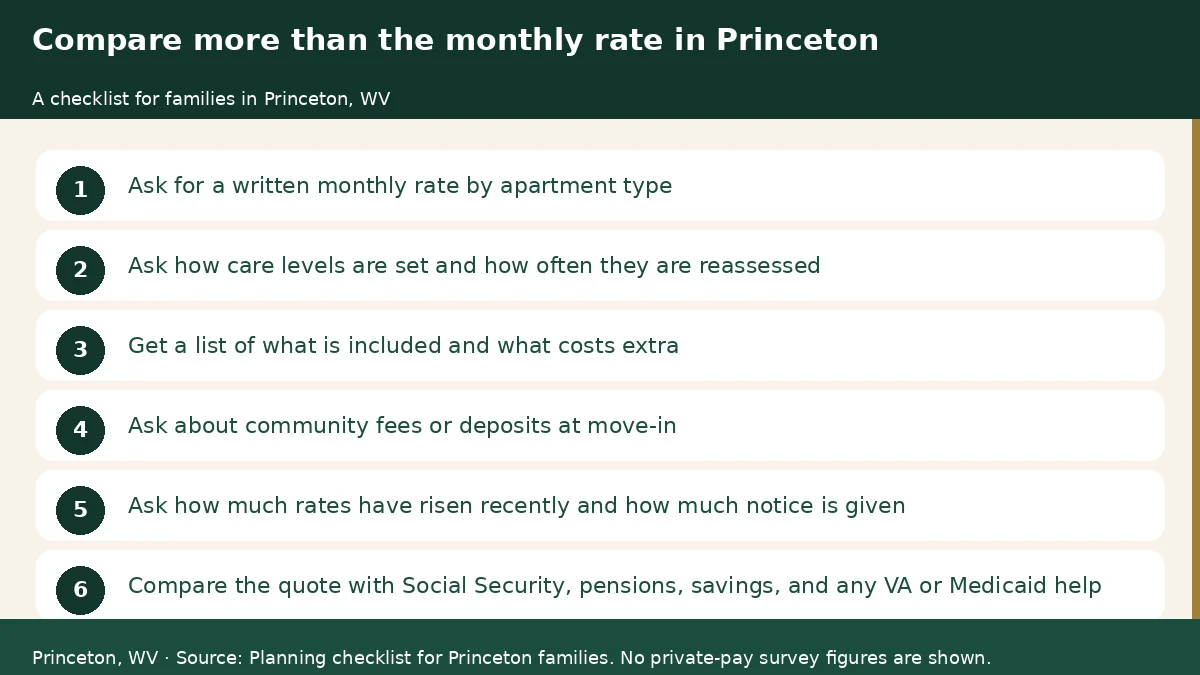
- How much notice do you give before raising rates?
Step 8: Review the contract carefully
Read the residency agreement before signing. Look at what is included, how care levels and rate increases work, notice requirements, and discharge policies. Consider having an elder law attorney review it.
Step 9: Involve your parent
Whenever possible, include your parent in the decision. People adjust better when they have had a voice. Even a parent with memory changes can often share preferences about a room, a view, or the kind of activities they enjoy.
Step 10: Plan the move
Once you choose, work with staff on a move-in date and a care plan. Bring familiar furniture, photographs, and a favorite blanket to make the new room feel like home. Plan to visit often during the first few weeks, and keep in close touch with staff as your parent settles in.
Special considerations in southern West Virginia
Families in Mercer County often weigh a few local factors:
- Winter roads. Snow and ice on hilly roads can make visiting harder. A community close to family can help.
- Distance to medical care. Ask how the community coordinates with local doctors and the hospital.
- Veterans. The Beckley VA Medical Center serves veterans in the region (VA Beckley health care). Ask whether the community helps residents get to VA appointments.
- Church and community ties. Staying near a home church or longtime friends can ease the transition.
Talking with current families
If a community allows it, ask whether you can speak with a family whose relative lives there now. Ask what surprised them, how staff communicate when something changes, and how problems were handled. One honest conversation can tell you more than a brochure. Keep in mind that every resident's experience is different, so weigh what you hear alongside your own observations.
Red flags to watch for
- Staff who cannot answer basic questions about care or costs
- Reluctance to share license or inspection information
- Pressure to sign quickly
- Residents who seem unkempt or unattended
- Strong odors or obvious cleanliness problems
If you have concerns about a facility, the long-term care ombudsman program, operated by Legal Aid of West Virginia, offers free, confidential help at 800-834-0598; the Beckley regional office serves Mercer County (Legal Aid of WV ombudsman program).
Visit GlenWood Park
GlenWood Park is a senior living campus at 1924 Glenwood Park Road in Princeton with assisted living and memory care, plus spaces such as dining rooms, a chapel, a library, and a salon you can see in our gallery. Please call (304) 425-8128 to confirm current services and to schedule a tour.
Frequently asked questions
How do I know if assisted living is right for my parent?
Assisted living fits when a parent needs help with daily activities but not ongoing daily nursing care. A doctor's input and a community's assessment can help confirm the fit.
How do I check an assisted living license in West Virginia?
Ask the community for its license and recent survey results, and contact the Office of Health Facility Licensure and Certification, which licenses assisted living residences in the state.
How many communities should we tour?
Two or three is a good number for most families. Visit each more than once, at different times of day.
Who can help Princeton families compare options?
The Aging and Disability Resource Center in Princeton, (304) 425-2040, and the long-term care ombudsman, 800-834-0598, can both help.