Assisted Living vs. In-Home Care: Comparing Costs in Princeton, WV
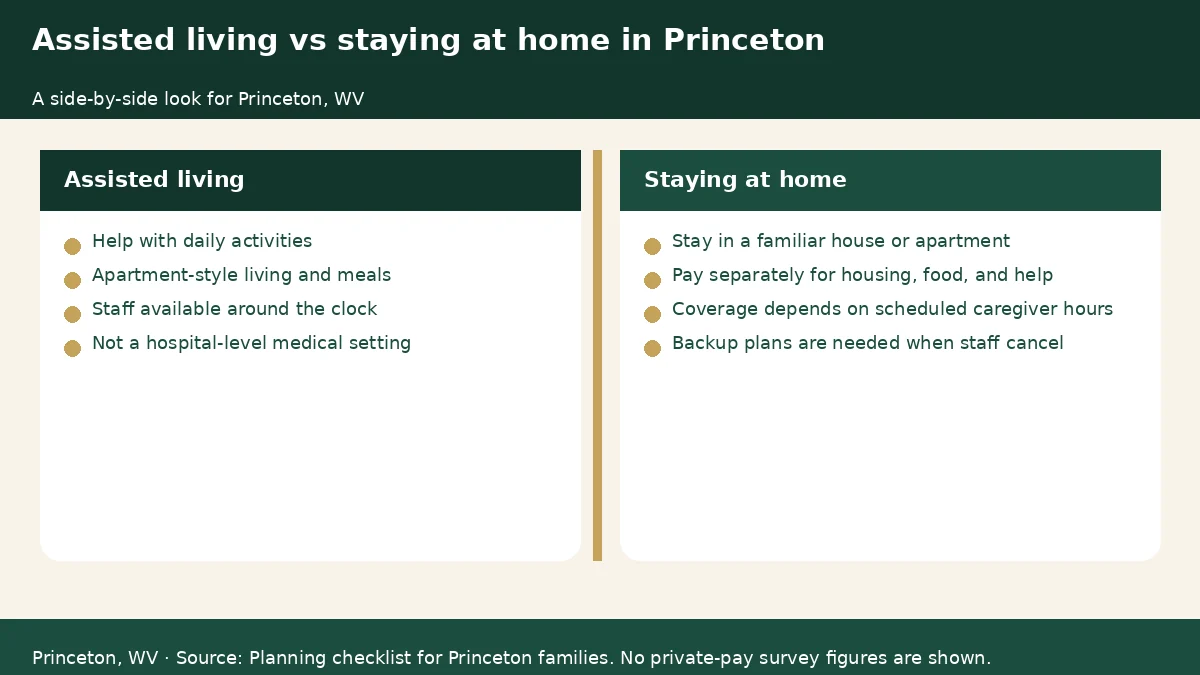
A fair comparison between assisted living and staying at home in Princeton should include housing, food, utilities, transportation, backup coverage, and unpaid family caregiving—not only an hourly caregiver rate. Ask agencies and communities for written estimates based on the hours and help actually needed.
Medicare does not pay for room, board, or ongoing custodial care in assisted living if that is the only care someone needs (Medicare.gov: long-term care coverage).
Eligible wartime Veterans and surviving spouses can review VA pension with Aid and Attendance. As of December 1, 2025, the maximum annual pension rate with Aid and Attendance is $29,093 for a Veteran with no dependents and $34,488 for a Veteran with one dependent (current VA pension rates). A surviving spouse’s Aid and Attendance maximum is $18,697 a year with no dependent children (VA Survivors Pension rates). These are benefit limits, not the price of a Princeton community. The net worth limit for these pensions is $163,699 from December 1, 2025, through November 30, 2026.
For local public-benefit counseling, start with the federal Eldercare Locator at 1-800-677-1116, which connects families to the Area Agency on Aging that serves Princeton, West Virginia.
Many Princeton families want a parent to stay at home as long as possible. In-home care can make that possible. But as needs grow, the cost of home care can rise quickly, and at some point assisted living may cost less while offering more. This guide compares 2025 costs for Princeton's survey area, explains what each option includes, and shows how West Virginia's Medicaid programs fit in.
The 2025 numbers
A fair comparison between assisted living and staying at home in Princeton should include housing, food, utilities, transportation, backup coverage, and unpaid family caregiving—not only an hourly caregiver rate. Ask agencies and communities for written estimates based on the hours and help actually needed.
Comparing at different levels of need
Your parent may need more or less.
These estimates multiply the hourly median by hours and by about 4.33 weeks a month. Agencies may set minimum visit lengths or charge different rates for nights and weekends.
What's included in each
In-home care
- Help with bathing, dressing, and personal care
- Light housekeeping and meal preparation
- Companionship and reminders
- Care only during scheduled hours
At home, your parent still pays for housing, utilities, food, property taxes, insurance, and repairs.
Assisted living
- A private or shared room
- Three meals a day and snacks
- Help with personal care and medications
- Housekeeping and laundry
- Activities and social time
- Staff available around the clock
When in-home care makes sense
- Your parent needs a few hours of help a day
- Your parent is safe alone at other times
- Family members can fill in gaps
- The home is safe and accessible
When assisted living may make more sense
- Your parent needs help at unpredictable times or overnight
- Your parent is lonely or isolated
- Home upkeep has become a burden
- Family caregivers are exhausted
- Home care hours are approaching the cost of assisted living
In rural parts of Mercer County, finding reliable home care aides can also be a challenge, particularly for evenings, weekends, and homes far from town.
How West Virginia Medicaid fits in
West Virginia's Aged and Disabled Waiver (ADW) helps people age 18 and older who meet a nursing home level of care and financial rules receive services in their own homes and communities (West Virginia ADW Program). The state's policy manual says ADW services may not be provided in assisted living or other group residential settings (BMS Chapter 501). For families who qualify, that can make in-home care more affordable than assisted living, which is generally private pay. See our guide to paying for assisted living in West Virginia.
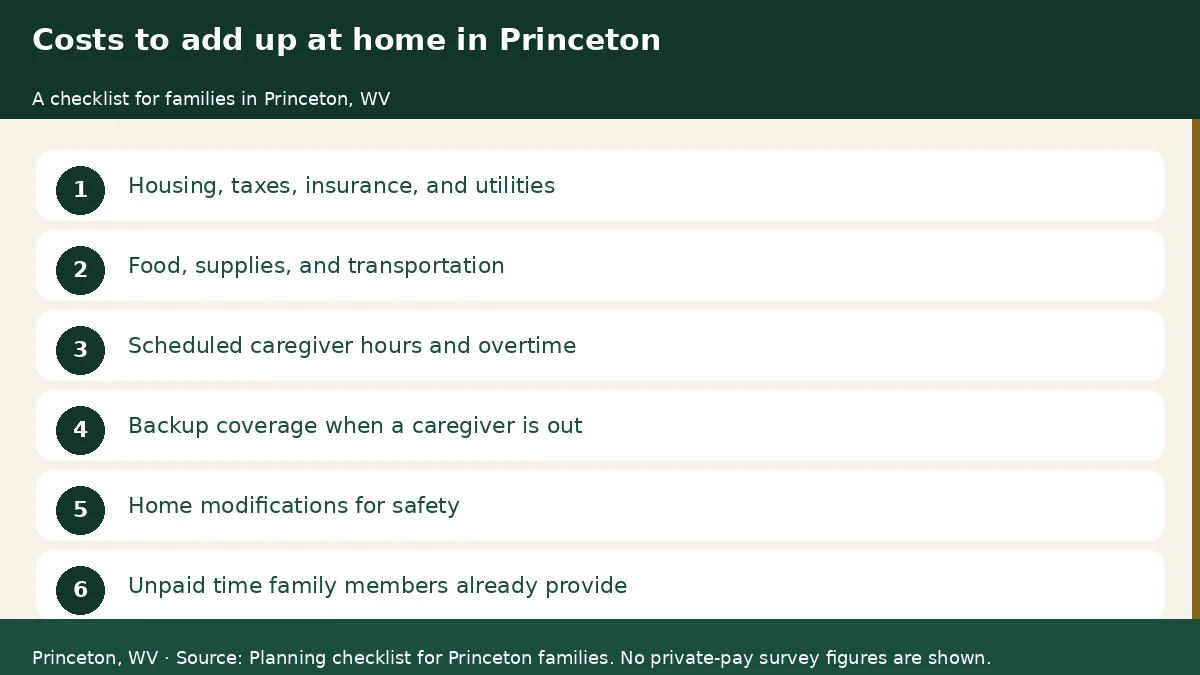
Don't forget hidden costs at home
- Home modifications such as grab bars, ramps, or a stair lift
- Medical alert systems
- Meal delivery
- Transportation to appointments
- Lost income for family caregivers
- Higher utility bills when someone is home all day
- Supplies such as incontinence products and bathroom aids
The role of family caregivers
In many Mercer County families, a spouse, daughter, or son provides much of the care at home, often unpaid. That care has real value, and it also has limits. Caregivers who are working, raising children, or managing their own health problems can reach a breaking point. When comparing costs, include an honest estimate of the hours family members are providing, and what it would cost to replace them if a caregiver became ill or simply could not continue. A plan that depends entirely on one exhausted person is fragile.
Questions to ask a home care agency
- What are your hourly rates for weekdays, nights, weekends, and holidays?
- Is there a minimum number of hours per visit?
- How are aides screened, trained, and supervised?
- What happens if an aide is sick or cannot reach the home in bad weather?
- Can the same aide come regularly?
Combining options
Some families combine in-home care with family help, adult day programs, or respite stays. The Aging and Disability Resource Center in Princeton, at 109 Thorn Street, can explain local options at (304) 425-2040 (West Virginia ADRC).
A worked example
Imagine a parent in Princeton who needs help each morning and evening with dressing, bathing, and medications, about four hours a day, seven days a week. If the same parent begins needing help at night, home care costs can quickly pass the cost of assisted living. Every family's numbers are different, so work through your own.
Revisiting the decision
The right choice today may not be the right choice next year. Many families start with a few hours of home care and revisit the plan every few months, or after any fall or hospital stay. Setting a regular check-in helps the family notice when needs are growing.
Thinking beyond cost
Cost is important, but it is not the only factor. Consider your parent's safety, social life, and wishes, as well as the health of family caregivers. Many people value staying in a familiar home; others find that assisted living brings relief from the work of running a household, and new friendships. Our article on signs it may be time for assisted living may help.
Talk with GlenWood Park
GlenWood Park, at 1924 Glenwood Park Road in Princeton, offers assisted living and memory care. Please call (304) 425-8128 to compare costs with your current care at home and to confirm current services and rates.
Frequently asked questions
Is in-home care cheaper than assisted living in Princeton?
It depends on hours. Fewer hours cost less; more hours can cost more.
How much is home care per hour in West Virginia?
There is no official federal or West Virginia private-pay median published for this type of care in Princeton. Ask each community for a written quote after an assessment.
Does West Virginia Medicaid pay for in-home care?
The Aged and Disabled Waiver can pay for in-home services for people who meet a nursing home level of care and financial rules.
Can the Aged and Disabled Waiver be used in assisted living?
No. State policy says ADW services may not be provided in assisted living or other group residential settings.