Assisted Living or Memory Care? How Princeton Families Can Decide
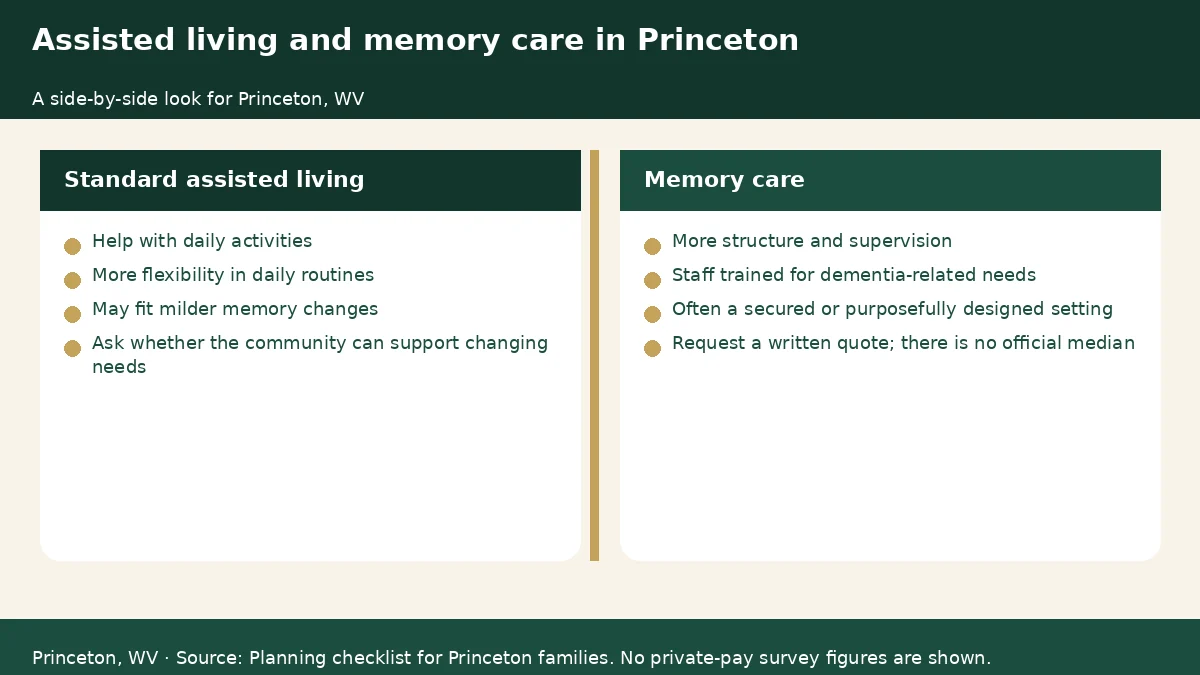
In Princeton, memory care is a more structured setting than standard assisted living, often with additional staffing and security. Whether someone needs that setting depends on their safety and daily-care needs, not on a national average price. Ask communities for written quotes for both options when both are appropriate.
Medicare does not pay for room, board, or ongoing custodial care in assisted living if that is the only care someone needs (Medicare.gov: long-term care coverage).
Eligible wartime Veterans and surviving spouses can review VA pension with Aid and Attendance. As of December 1, 2025, the maximum annual pension rate with Aid and Attendance is $29,093 for a Veteran with no dependents and $34,488 for a Veteran with one dependent (current VA pension rates). A surviving spouse’s Aid and Attendance maximum is $18,697 a year with no dependent children (VA Survivors Pension rates). These are benefit limits, not the price of a Princeton community. The net worth limit for these pensions is $163,699 from December 1, 2025, through November 30, 2026.
For local public-benefit counseling, start with the federal Eldercare Locator at 1-800-677-1116, which connects families to the Area Agency on Aging that serves Princeton, West Virginia.
When a parent in Princeton needs more help than home can provide, families often find themselves weighing two options that sound similar: assisted living and memory care. Both offer a safe place to live, meals, and help with daily activities. But they are designed for different needs. Choosing the right one can make daily life calmer and safer for your parent, and can help avoid a second move soon after the first. This guide compares the two and explains how to decide.
What assisted living offers
Assisted living is for older adults who are mostly independent but need help with some daily activities, such as bathing, dressing, managing medications, or getting to meals. Residents usually have their own apartment or room, take part in activities as they choose, and come and go with some freedom.
Under West Virginia law, an assisted living residence serves four or more residents who need personal assistance or supervision because of physical or mental impairment, and may provide nursing care only at a level no greater than limited and intermittent nursing care (W. Va. Code § 16B-5-2). The law defines limited and intermittent nursing care as no more than two hours of nursing care a day for no longer than 90 consecutive days per episode, with exceptions for hospice and Medicare-certified home health services.
What memory care offers
Memory care is for people living with Alzheimer's disease or another form of dementia whose needs go beyond what standard assisted living can safely provide. It generally includes:
- A secure environment with monitored exits to reduce the risk of wandering
- Staff trained in dementia care, including calm redirection and nonverbal communication
- A structured daily routine that offers predictability
- Activities adapted to each person's abilities, such as music, simple tasks, and sensory activities
- More hands-on help with eating, dressing, and personal care
West Virginia's Office of Health Facility Licensure and Certification lists Alzheimer's/Dementia Special Care Units as a separate licensed facility type (OHFLAC). Ask any community how its memory care program is licensed.
Memory care provides support and a safer environment. It does not reverse or cure dementia.
Side by side
| Assisted living | Memory care | |
|---|---|---|
| Who it serves | Older adults needing some daily help | People living with dementia |
| Environment | Open, with more independence | Secured, simplified, calm |
| Staffing | Help with daily activities | More staff time and dementia training |
| Activities | Broad social calendar | Structured, ability-based |
| Cost | Lower | Higher |
The cost difference
The survey does not report memory care separately. See our guide to memory care costs in Princeton.
Signs assisted living may be the right fit
- Your parent needs help with a few daily tasks but can follow conversation and make choices
- Medication reminders and meals would solve most problems
- Your parent is lonely at home and would enjoy company
- Memory changes are mild and your parent does not wander
Signs memory care may be the better fit
- Wandering or trying to leave home, especially at night
- Getting lost on familiar roads around Princeton or Bluefield
- Not recognizing danger, such as a hot stove
- Needing step-by-step cues for dressing or bathing
- Agitation or confusion that standard assisted living staff may not be able to manage
What about early dementia?
Many people in the early stages of dementia do well in assisted living, especially with reminders and a predictable routine. The question is how quickly needs may change. Ask your parent's doctor what to expect, and ask each community what happens if your parent later needs memory care. A campus with both options can make a later transition easier.
Trial periods and respite stays
Some communities offer short respite stays, which can let a parent experience a setting for a week or two before a permanent move. Ask whether this is available and whether it can be used to see how your parent responds to assisted living or memory care.
Talk to your parent's doctor
A physician can help you understand your parent's current abilities and likely needs. An assessment by a geriatric specialist or memory clinic can be especially useful. Bring notes on recent incidents, such as missed medications, falls, or getting lost, so the doctor has a clear picture. Many communities also complete their own assessment before move-in.
Questions to ask any community
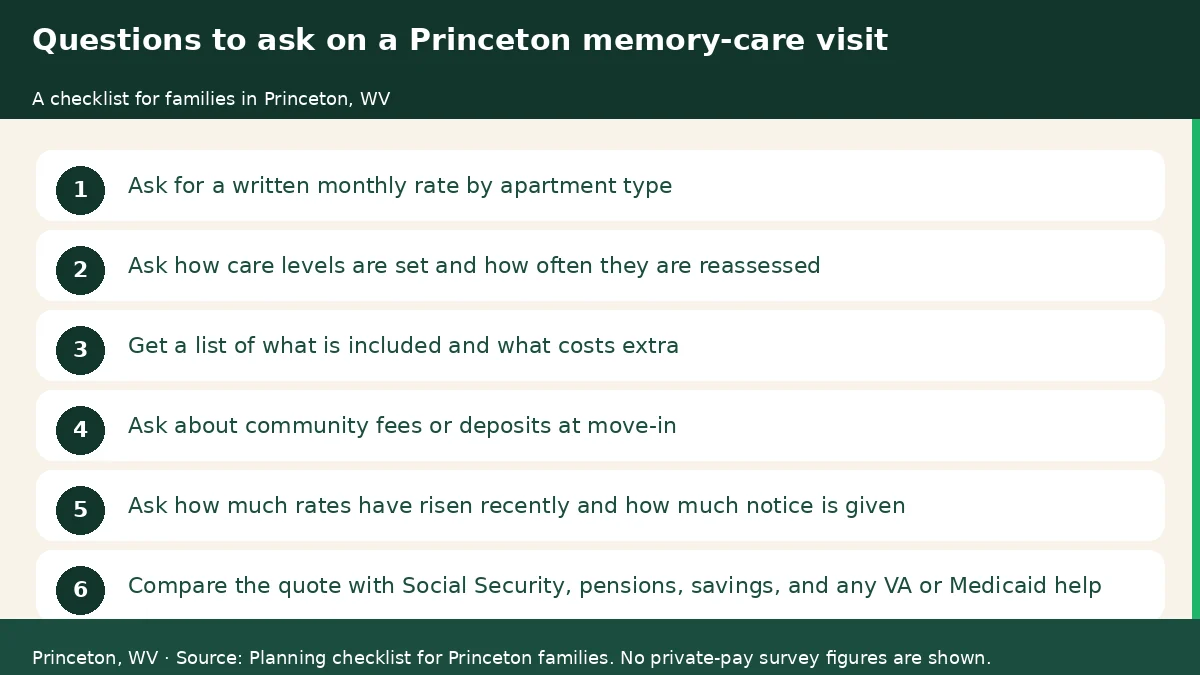
- How do you decide whether someone belongs in assisted living or memory care?
- What dementia training do staff receive?
- How do you prevent and respond to wandering?
- How do you handle sundowning and agitation?
- What happens if my parent's needs exceed what you can provide?
- How do rates change if my parent moves from assisted living to memory care?
Helping your parent adjust
Whichever setting you choose, the first weeks can be unsettling. Familiar belongings, such as a favorite chair, quilt, or photographs, help a new room feel like home. Share your parent's routines, preferences, and life story with staff so they can connect with your parent as a person. Visit often at first, but follow staff guidance if short, calm visits seem to work better than long ones.
When families disagree
It is common for siblings or spouses to see a parent's needs differently, especially when one person lives nearby and sees the daily struggles while others visit only occasionally. A shared written log of incidents, a joint visit to the doctor, and tours of both assisted living and memory care settings can help everyone reach the same understanding. The goal is not to win an argument, but to find the setting where your parent will be safe and as comfortable as possible.
Talk with GlenWood Park
GlenWood Park at 1924 Glenwood Park Road in Princeton presents both assisted living and memory care. Please call (304) 425-8128 to confirm how each program is currently structured, what is available, and what it costs, or contact us to visit.
Frequently asked questions
What is the main difference between assisted living and memory care?
Assisted living helps with daily activities in an open setting. Memory care adds a secure environment, dementia-trained staff, and structured routines for people living with dementia.
Can someone with dementia live in assisted living in West Virginia?
Many people in the early stages do well in assisted living. As needs grow, memory care may be safer. West Virginia licenses Alzheimer's/Dementia Special Care Units as a separate facility type.
Is memory care more expensive than assisted living?
Yes.
How much nursing care can West Virginia assisted living provide?
State law limits it to limited and intermittent nursing care, defined as no more than two hours a day for no longer than 90 consecutive days per episode, with exceptions for hospice and Medicare-certified home health.