Assisted Living vs. Nursing Home Costs in Princeton, West Virginia
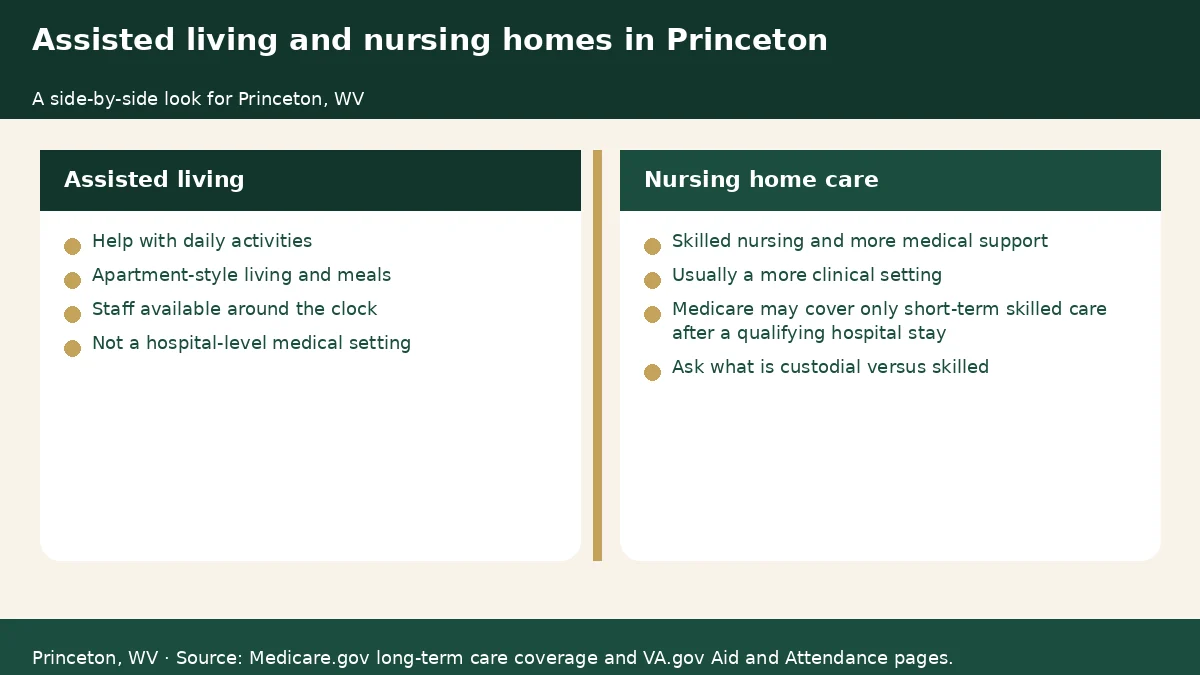
Assisted living and nursing home care are not interchangeable. Nursing homes provide round-the-clock skilled nursing; assisted living is meant for people who need help with daily activities rather than ongoing medical care. Ask each Princeton provider for a written comparison that lists what is included.
Medicare does not pay for room, board, or ongoing custodial care in assisted living if that is the only care someone needs (Medicare.gov: long-term care coverage).
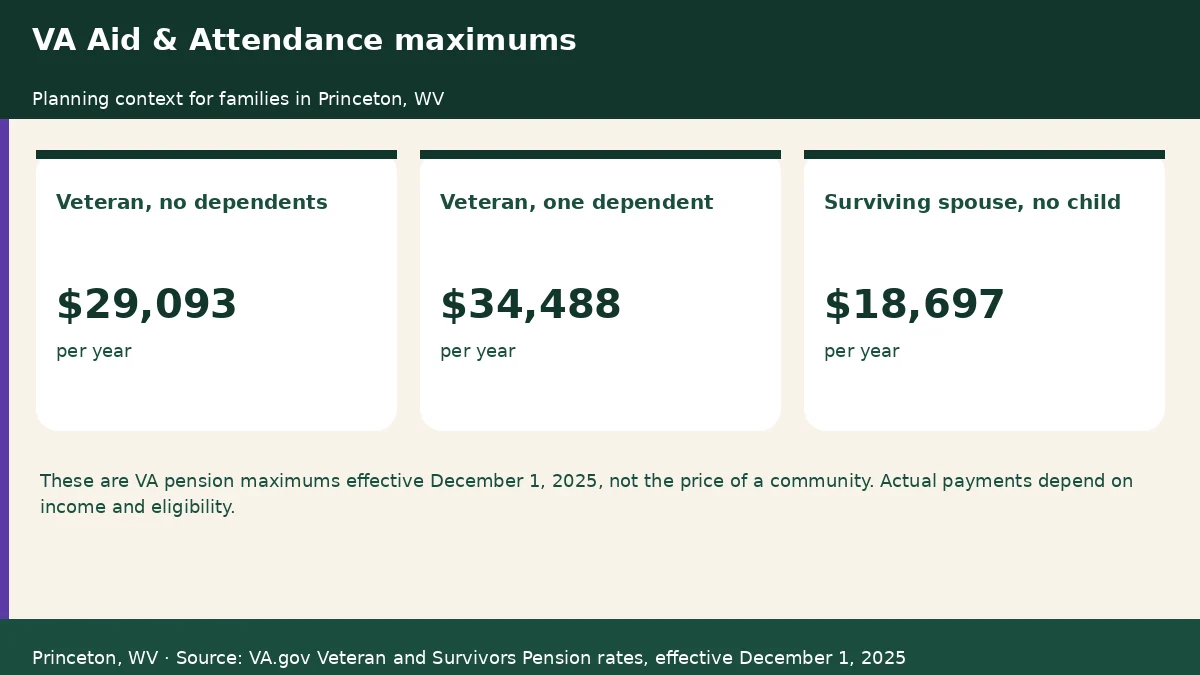
Eligible wartime Veterans and surviving spouses can review VA pension with Aid and Attendance. As of December 1, 2025, the maximum annual pension rate with Aid and Attendance is $29,093 for a Veteran with no dependents and $34,488 for a Veteran with one dependent (current VA pension rates). A surviving spouse’s Aid and Attendance maximum is $18,697 a year with no dependent children (VA Survivors Pension rates). These are benefit limits, not the price of a Princeton community. The net worth limit for these pensions is $163,699 from December 1, 2025, through November 30, 2026.
For local public-benefit counseling, start with the federal Eldercare Locator at 1-800-677-1116, which connects families to the Area Agency on Aging that serves Princeton, West Virginia.
For families in Princeton, the choice between assisted living and a nursing home is often driven by care needs first and cost second. But in West Virginia, the cost difference between the two is unusually large, so it is worth understanding. This guide compares 2025 costs for Princeton's survey area, explains what each setting provides, and covers how Medicaid and Medicare fit in.
The 2025 numbers
In other words, a semi-private nursing home room in this part of West Virginia costs more than twice as much as assisted living. These are survey medians, not quotes; actual prices vary by community.
Why the difference is so large
A nursing home is a licensed health care facility that provides 24-hour nursing care, including care from registered and licensed practical nurses, rehabilitation, and help for people with complex medical needs. Assisted living provides personal assistance and supervision, with nursing care limited by West Virginia law to "limited and intermittent" care, defined as no more than two hours a day for no more than 90 consecutive days per episode, with exceptions for hospice and Medicare-certified home health (W. Va. Code § 16B-5-2). The higher staffing and medical capability of a nursing home drive its cost.
Who belongs in each setting
Assisted living may fit when your parent:
- Needs help with bathing, dressing, or medications
- Is medically stable
- Wants privacy and independence, with help nearby
- Would benefit from company, meals, and activities
A nursing home may be needed when your parent:
- Needs daily skilled nursing, such as complex wound care or injections a caregiver cannot give
- Needs help from two people to move, or is bedbound
- Has frequent medical changes that require nurse monitoring
- Is recovering from a hospital stay and needs short-term rehabilitation
How Medicare and Medicaid fit in
Medicare does not pay for long-term custodial care in either setting. It can cover a limited, short-term skilled nursing facility stay after a qualifying hospital stay, when daily skilled care is needed (Medicare: Skilled nursing facility care).
West Virginia Medicaid can cover long-term nursing home care for people who meet medical and financial rules. It does not have a waiver for assisted living, and its Aged and Disabled Waiver serves people in their own homes (West Virginia ADW Program). That creates a practical tension: assisted living costs less, but most families pay for it privately, while nursing home care costs more but can be covered by Medicaid once a person qualifies. See our guide to paying for assisted living in West Virginia.
Thinking about the long term
For a parent who could live well in either setting, assisted living can stretch savings much further. Many families start in assisted living and plan for the possibility of nursing home care later, ideally with advice from an elder law attorney.
Daily life in each setting
Cost is only part of the picture. Assisted living is designed to feel like home: private rooms or apartments, flexible routines, and social activities. A nursing home is a medical setting by necessity, though many work hard to be warm and personal. For someone who does not need daily skilled care, the more home-like environment of assisted living is often a better match for quality of life.
Short-term rehabilitation versus long-term care
Families sometimes first meet a nursing home after a hospital stay, when a parent goes for short-term rehabilitation following a fall, surgery, or illness. That stay is different from long-term care. When rehabilitation ends, the question becomes where your parent should live next: back home, in assisted living, or in long-term nursing care. Ask the rehabilitation team for a frank assessment of your parent's abilities, and start looking at options before the discharge date. Hospital and rehabilitation social workers can help, but decisions are easier when a family has already toured.
Hidden costs to ask about
Whichever setting you choose, ask about costs outside the base rate. In assisted living, these can include higher care levels, medication management, incontinence supplies, and transportation. In a nursing home, ask what is covered by Medicare, Medicaid, or insurance and what is billed privately, such as a private room, personal laundry, or salon services.
Checking quality
For nursing homes, Medicare's Care Compare tool shows inspection results, staffing, and quality measures (Medicare Care Compare). For assisted living, ask the residence about its license and recent surveys from West Virginia's Office of Health Facility Licensure and Certification (OHFLAC). The long-term care ombudsman, run by Legal Aid of West Virginia, can answer questions about residents' rights in both settings at 800-834-0598 (Legal Aid of WV ombudsman program).
Location and family visits
For many Mercer County families, being close enough to visit often matters as much as cost. Frequent visits help a parent settle in and help family members notice changes early. When comparing options, consider how far each is from the family members who will visit most.
Questions to ask
- What level of nursing care can you provide, and for how long?
- What happens if my parent needs more care than you can give?
- Do you accept Medicaid, and if so, for which services?
- What is included in the monthly rate, and what costs extra?
Talk with GlenWood Park
GlenWood Park in Princeton offers assisted living and memory care. Please call (304) 425-8128 to talk through which setting fits your parent's needs and to confirm current services and rates.
Frequently asked questions
Is a nursing home more expensive than assisted living in Princeton?
Yes.
Does Medicaid pay for nursing homes in West Virginia?
Yes, for people who meet medical and financial eligibility rules. West Virginia Medicaid does not have an assisted living waiver.
Does Medicare pay for a nursing home?
Medicare may cover a short skilled nursing facility stay after a qualifying hospital stay. It does not pay for long-term custodial care.
Can someone in assisted living receive nursing care?
West Virginia law allows limited and intermittent nursing care, up to two hours a day for no more than 90 consecutive days per episode, with exceptions for hospice and Medicare-certified home health.